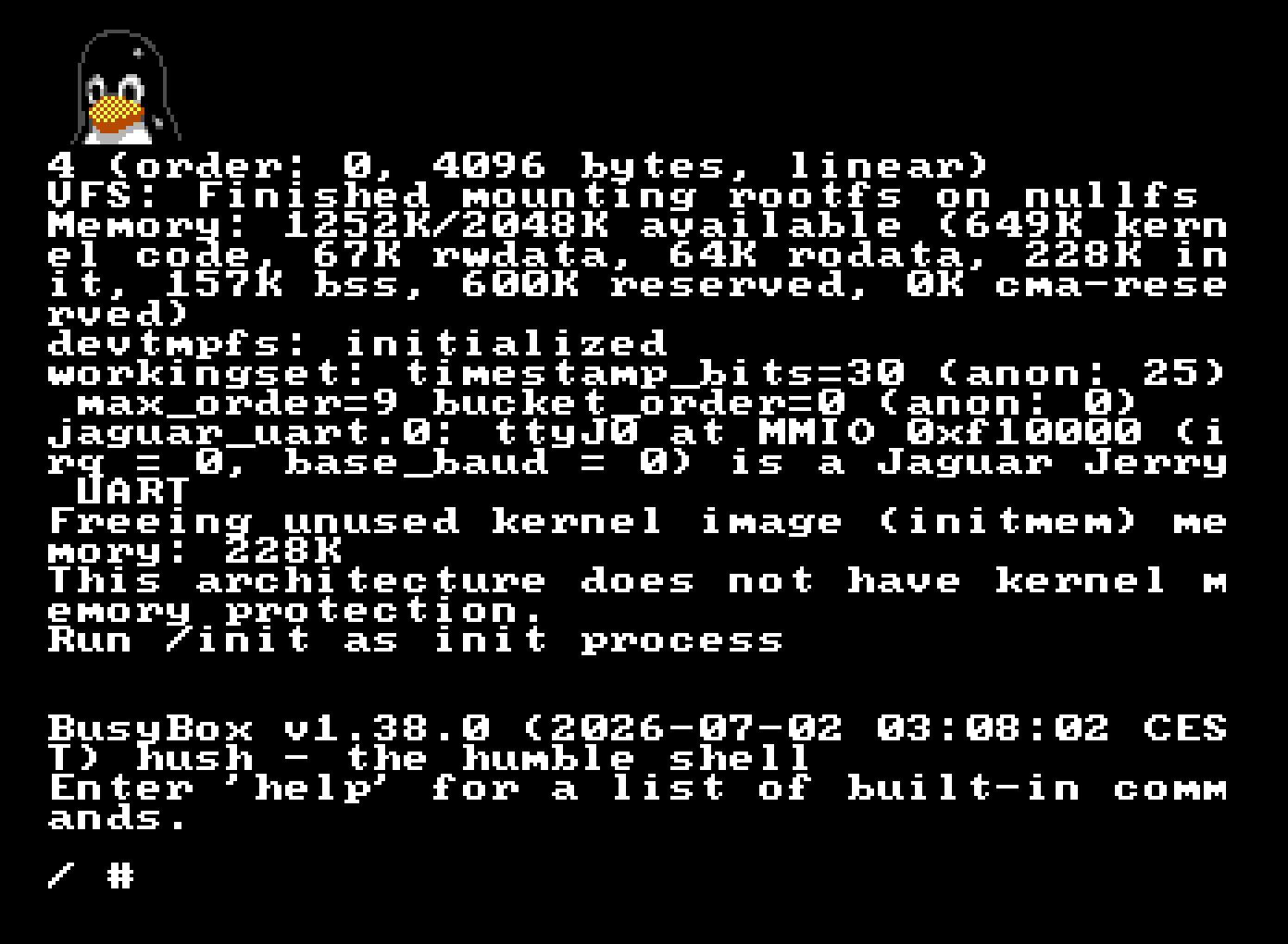
After successfully porting Linux to the Sega MegaDrive, developers have now implemented the ability to run the Linux kernel with a set of Busybox utilities on the classic game console Atari Jaguar released in 1993. The Atari Jaguar was equipped with a Motorola 68000 CPU, 2 MB of RAM, and could use cartridges of up to 6 MB for storage. It also featured two coprocessors, Tom (GPU) and Jerry (DSP) for graphics and audio processing.
Similar to the Sega MegaDrive port, the 7.2.0-rc1 kernel for the Atari Jaguar was compiled in “NOMMU” mode due to the lack of a Memory Management Unit (MMU) on the Motorola 68000 CPU. This allowed the use of a flat memory model with a linear address space. The limited RAM issue was addressed by dividing the kernel components into separate memory areas on the cartridge and RAM.
To execute kernel code without copying it to RAM, the execute-in-place (XIP) mechanism was utilized. Additionally, a hack was used to copy interrupt vectors to RAM since the CPU looked for them at a different address. The lack of a timer on the CPU was resolved by using timers from the DSP for sound synthesis to activate the task scheduler.
To build user space components, developers used the Buildroot toolkit with patches from the LinuxMD project. Memory was saved during initialization by directly calling the command shell and using a simplified malloc function. Control was transferred directly to the kernel without using a bootloader.