
Qualcomm Introduces Qualcomm Linux 2.0 for IoT Platforms
Qualcomm introduced Linux distribution Qualcomm Linux 2.0, providing a software stack optimized for IoT platforms Qualcomm Dragonwing. The project implements a unified distribution that allows you to quickly create solutions for various Qualcomm SoCs, such as QCS5430, QCS6490, IQ-8275, IQ-9075 and IQ-615. As a basis, Qualcomm Linux uses tools and meta-packages from the Yocto and OpenEmbedded projects, supplemented by patches, drivers, firmware, packages and configuration files to support specific hardware blocks used in the chips Qualcomm.
The distribution is developed using an open development model and transfers prepared changes to upstream projects. Qualcomm’s proprietary components are integrated into the distribution in the form of explicitly dedicated modular overlays. The proposed software stack supports all processors, subsystems and components of the Qualcomm platform, including CPU, GPU and various hardware accelerators for AI, data processing and multimedia operations (VPU, DPU, NPU, DSP). In addition to the Yocto-based user environment, it includes a bootloader with verified boot capability, UEFI firmware and packages with the Linux kernel supported by Qualcomm engineers, including additional drivers and patches.
The platform is marked as completely ready for creating working systems based on Qualcomm equipment. Features such as virtualization support, mandatory access control using SELinux, testing of all components on reference hardware, a long package maintenance cycle for all supported platforms, and the ability to integrate your own BSP (Board Support Package) and OEM layers are provided. To update, overwriting the system image or automatically delivering updates in OTA mode can be used.
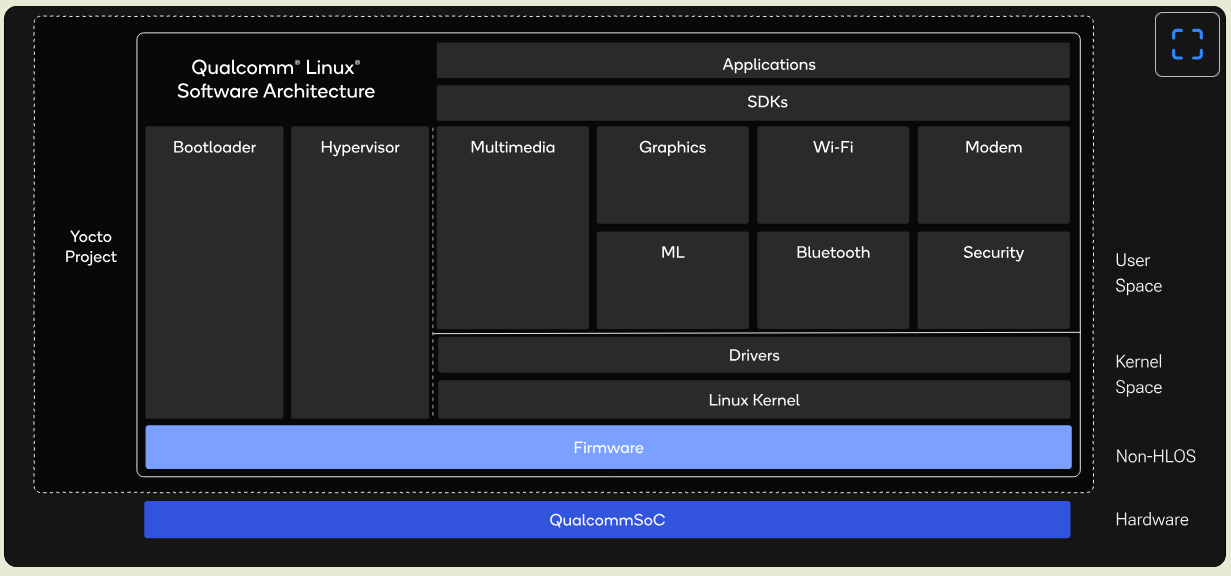
The release of Qualcomm Linux