
Published results of latency testing when using input devices in games running in X11 and Wayland-based environments. Additionally, the impact of enabling an adaptive change in the screen refresh rate (VRR, variable refresh rate) and using the dxvk-low-latency fork with optimizations to reduce latency instead of DXVK were assessed. Testing confirmed the opinion among players that X11-based environments allow for higher input responsiveness than when using Wayland. The beneficial effect on responsiveness of enabling VRR and using dxvk-low-latency has also been confirmed.
Latency measurements were carried out using a homemade hardware device based on a Raspberry Pi RP2040 microcontroller and a photodiode, which simulates a USB mouse and measures the time between the generated click and the change in screen brightness. Testing was carried out on a computer with an AMD Ryzen 7 5800X3D CPU and an NVIDIA GeForce RTX 4070 SUPER GPU. The distribution used was CachyOS with the Linux kernel 7.1.3, the proprietary NVIDIA driver 610.43.03 and the KDE Plasma 6.7.2 desktop. The measurement was carried out in the Windows game Diabotical based on the DirectX 11 graphics API, launched through the Proton 11.0 package.
The lowest latencies were achieved in combination with X11 with VRR and dxvk-low-latency – 4.21 ms. In second place was the Wayland + VRR + dxvk-low-latency configuration – 4.38 ms. The average latency when using pure X11 was 4.79 ms, and Wayland was 4.93 ms. The difference of 0.14 and 0.22 ms is noted as too small for players to recognize. It is expected that thanks to KWin optimization initiatives, the difference between X11 and Wayland will be reduced in the near future.
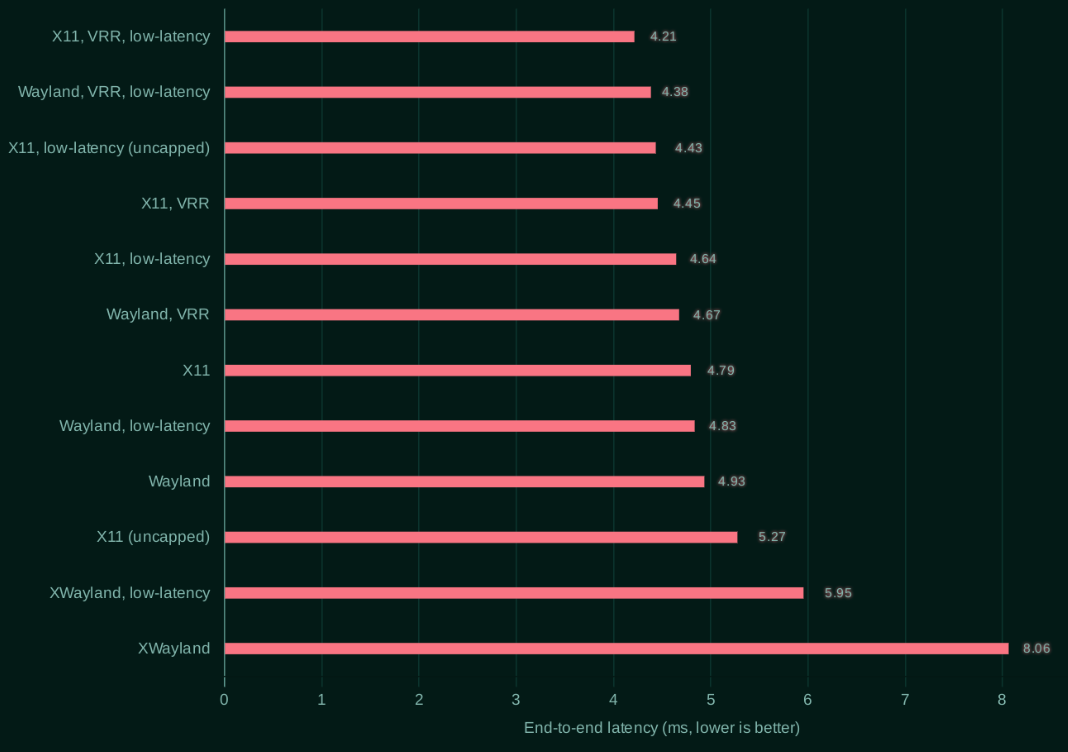
At first glance, VRR and dxvk-low-latency do not significantly reduce latency, but in addition to delays, their use narrows the spread of values, smooths out performance peaks, evens out FPS and makes delays more predictable in real conditions, in which the load on the GPU and CPU is constantly changing.
The worst performance was found in XWay