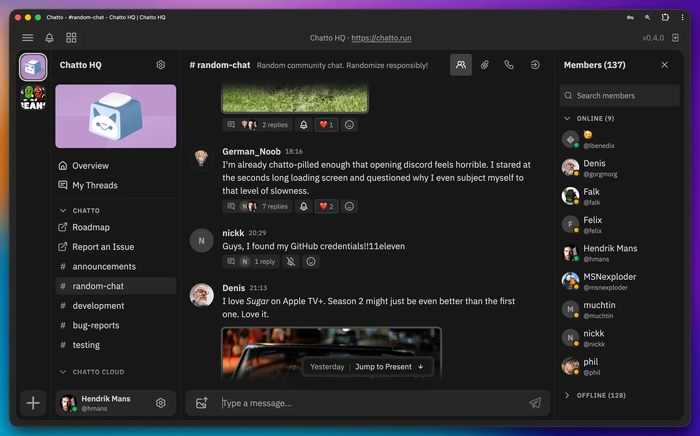
Chat platform Chatto, originally designed for organizing communication in communities and development teams, has officially been transferred to the category of open projects. The platform is focused on maximizing the responsiveness of the interface, minimizing backend resource consumption, and simplifying the deployment of group chat infrastructure on self-hosted servers without relying on external services. Users access the platform through a browser-based web interface. The codebase, written in Go, is now open source under the AGPLv3 license and can be found on GitHub.
All personal data and chat history are stored in encrypted form using keys tied to individual users. Chatto supports not only text chat but also voice and video calls, multimedia message embedding, screen sharing, and end-to-end message encryption. Additional features include full-text search, link previews, user presence detection, status setting, and role-based access control.
The platform allows for customization through plug-ins and integration with corporate systems via GraphQL and NATS APIs. Installation is simple, requiring the execution of a standalone executable file of about 70 MB in size, without the need for additional dependencies or an external database management system.
Although the project is stable enough for production applications, not all planned features have been implemented yet. The upcoming Chatto 0.5 release aims to introduce moderation capabilities, content complaint functionalities, and support for connecting to multiple servers on the client side. The team plans to release Chatto 1.0.0 within 6-12 months, allowing for changes that may impact backward compatibility.