
Flipper Devices introduced the Flipper One project, which aims to develop a portable computer targeting network engineers, enthusiasts, and security researchers. The design of the device resembles a game console and features a computer that can function both as a standalone testing tool for security assessments, network diagnostics, and traffic analysis, as well as a portable workstation when connected to a monitor, keyboard, and mouse. The project is a collaborative effort with the community and utilizes open source firmware to create the most open and documented computer on ARM architecture, fully supported in the standard Linux kernel.
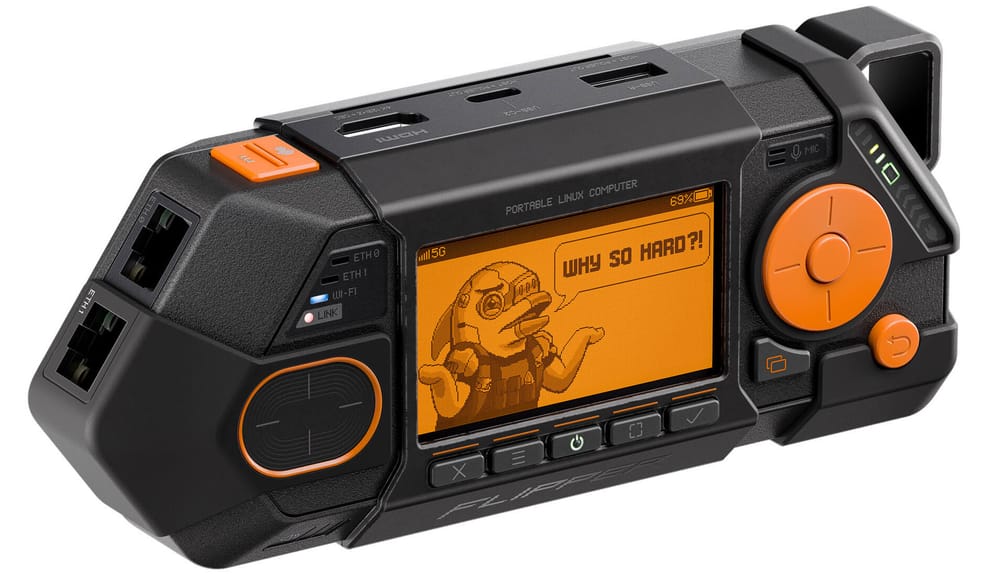
Described as a versatile tool, Flipper One provides a range of functionalities such as creating wireless access points and routers, emulating USB devices, running server processes in containers, analyzing network packets, establishing VPN connections, integrating with various hardware sensors and modules via the GPIO port, operating as a transceiver with software signal modulation (SDR), serving as a 5G/LTE network analyzer, a power bank, a 5G/LTE modem, and a multimedia set-top box.
The concept of the Flipper One project is a significant departure from the previous device, Flipper Zero, and involves a complete reimagining of the technology. Flipper Zero was built on the STM32WB55 microcontroller and focused on analyzing access control protocols, NFC, RFID, wireless radio communications below 1 Gigahertz, infrared communication systems, and wired connection technologies like iButton, UART, SPI, and I²C.
With Flipper One, the device will feature both a microcontroller and a high-performance ARM processor capable of running Linux and handling multimedia content. This new iteration expands the low-level signal analysis capabilities to conduct research on network technologies and protocols, including Wi-Fi, Ethernet, 5G, and satellite communications. The device is equipped with enough processing power for software analysis of radio signals and local execution of machine learning models.