
Representatives of the European Organization for Nuclear Research (CERN) revealed during their speech at the MiniDebConf conference their plans to transition from RHEL to Debian by the end of 2026 for more than 2,200 industrial and embedded computers utilized to control the accelerator complex, which includes the Large Hadron Collider and various experimental facilities. According to reports, this migration will not impact data centers and experimental systems that will continue to utilize RHEL/AlmaLinux.
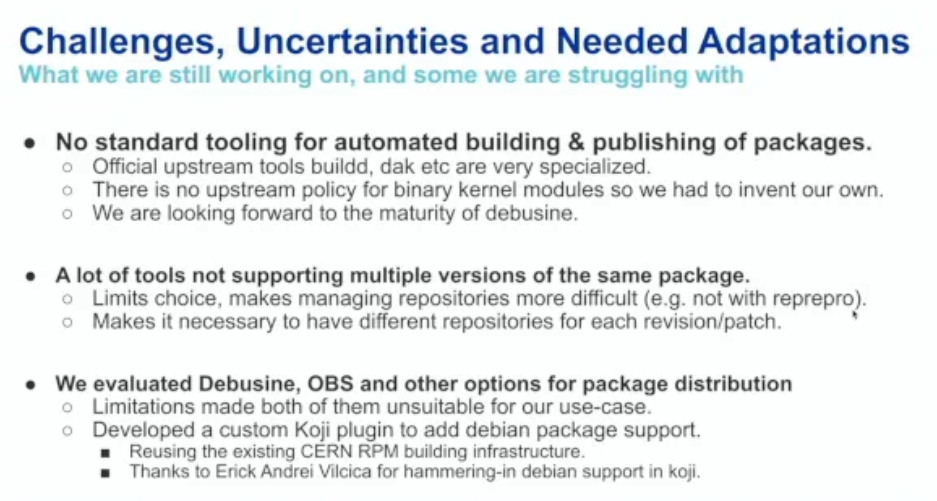
Initially, CERN engineers considered migrating to CentOS Stream but decided against it due to the assembly of packages for the architecture x86-64-v2 (“-march=x86-64-v2”), which does not support older hardware due to specific extensions like SSE3, SSE4_2, SSSE3, POPCNT, LAHF-SAHF, and CMPXCHG16B. Challenges encountered during the transition to Debian included the absence of comprehensive standard tools for automated package building and publishing, as well as the absence of an official policy regarding binary kernel modules and issues with certain tools supporting multiple versions of a package in one repository.
CERN was previously a key developer of the Scientific Linux distribution, which was discontinued in 2019 in favor of CentOS. Following a change in Red Hat’s policy regarding CentOS maintenance and the premature end of support for the CentOS 8 branch in 2022, CERN transitioned to AlmaLinux as the standard distribution for ongoing experiments. However, existing systems based on CentOS and RHEL will be utilized until the end of their life cycles.