The Linux Foundation presented the twenty-first release of the distribution AGL UCB (Automotive Grade Linux Unified Code Base), which is developing a universal platform for use in various automotive subsystems, from dashboards to automotive infotainment systems. At the same time, the first release of the AGL SoDeV (Software Defined Vehicle) reference platform, designed for creating software-defined automotive systems based on Automotive Grade Linux.
SoDeV is a combined product that combines the AGL UCB distribution, LXC (Linux Containers), VirtIO, the Xen hypervisor, Zephyr RTOS and other Linux Foundation projects. The first release of SoDeV can run on Renesas Sparrow Hawk boards, in cloud environments or in virtual machines. The project allows automakers to accelerate product time to market by decoupling software development from hardware systems, abstracting hardware through virtualization. During 2026, they plan to implement broader support for SoCs used by automakers. The project is being developed with the participation of Panasonic Automotive Systems, Honda, Toyota, Mazda, AISIN and Renesas.
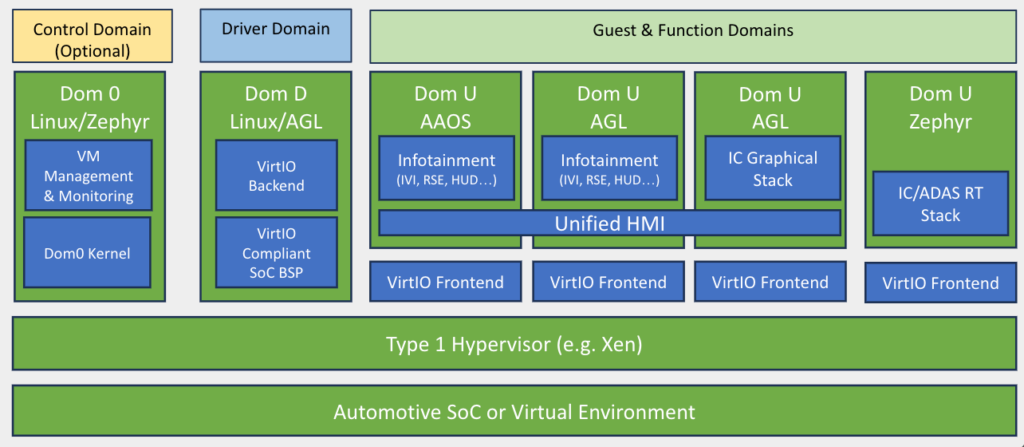
The AGL UCB distribution is based on the developments of the projects Tizen, GENIVI and Yocto. The graphical environment is based on Qt, Wayland and the developments of the Weston IVI Shell project. Demo assemblies of the platform generated for QEMU, Renesas H3, Intel Up², Raspberry Pi 4 and Raspberry Pi 5 boards. Companies such as Toyota, Ford, Nissan, Honda, Jaguar Land Rover, Mazda, Mitsubishi and Subaru.
AGL UCB can be used by automakers as a framework for creating final solutions, after carrying out the necessary adaptation for equipment and customizing the interface.