
Published release of a Unix-like operating system ToaruOS 2.3, written from scratch and supplied with its own kernel, bootloader, standard C library, package manager, user space components and a graphical interface with composite window manager. The project initially developed at the University of Illinois as research work in the field of creating new composite graphical interfaces, but then transformed into a separate operating system. The project code is written in C and distributed under the BSD license. A live image has been prepared for download, 7.4 MB in size, which can be tested in QEMU, VMware or VirtualBox.
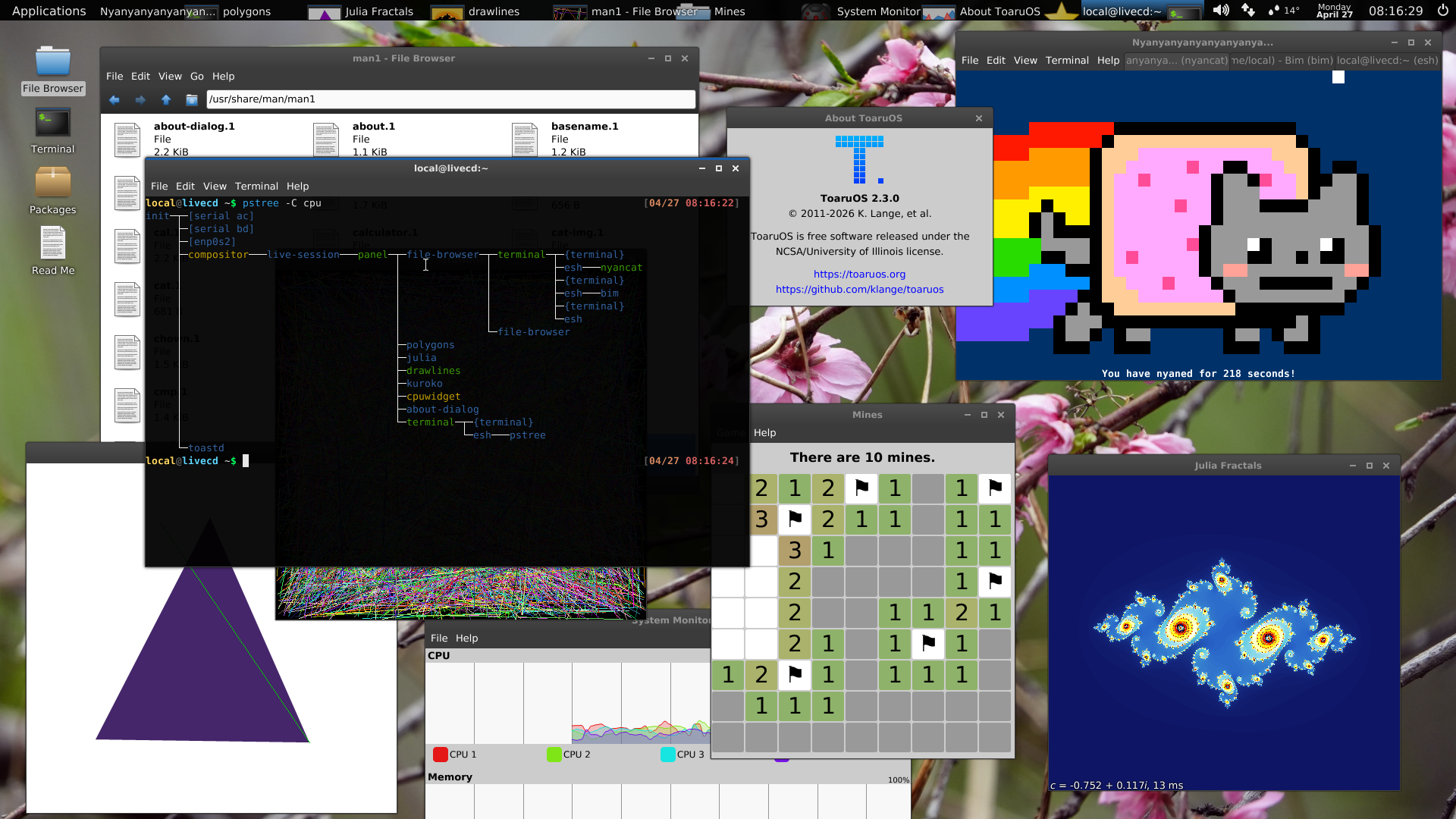
ToaruOS is based on a kernel that uses a hybrid modular architecture that combines a monolithic framework and tools for using loadable modules, which are the form of most available device drivers, such as disk drivers (PATA and ATAPI), EXT2 and ISO9660 file systems, framebuffer, keyboard, mouse, network cards (AMD PCnet FAST, Realtek RTL8139 and Intel PRO/1000), sound chips (Intel AC’97), as well as VirtualBox add-ons for guest systems. The kernel supports Unix threads, TTY, virtual FS, pseudo-FS /proc, multithreading, IPC, ramdisk, ptrace, shared memory, multitasking and other standard features.
The system is equipped with composite window manager, supports dynamically linked ELF executables, multitasking, graphics stack, can run Python 3 and GCC. ext2 is used as the file system. The bootloader supports BIOS and EFI. The network stack allows the use of BSD-style socket APIs and supports network interfaces, including loopback.
Among the native applications, the Vi-like code editor Bim stands out, which has been used for the last few years to develop ToaruOS-specific applications, such as a file manager, a terminal emulator