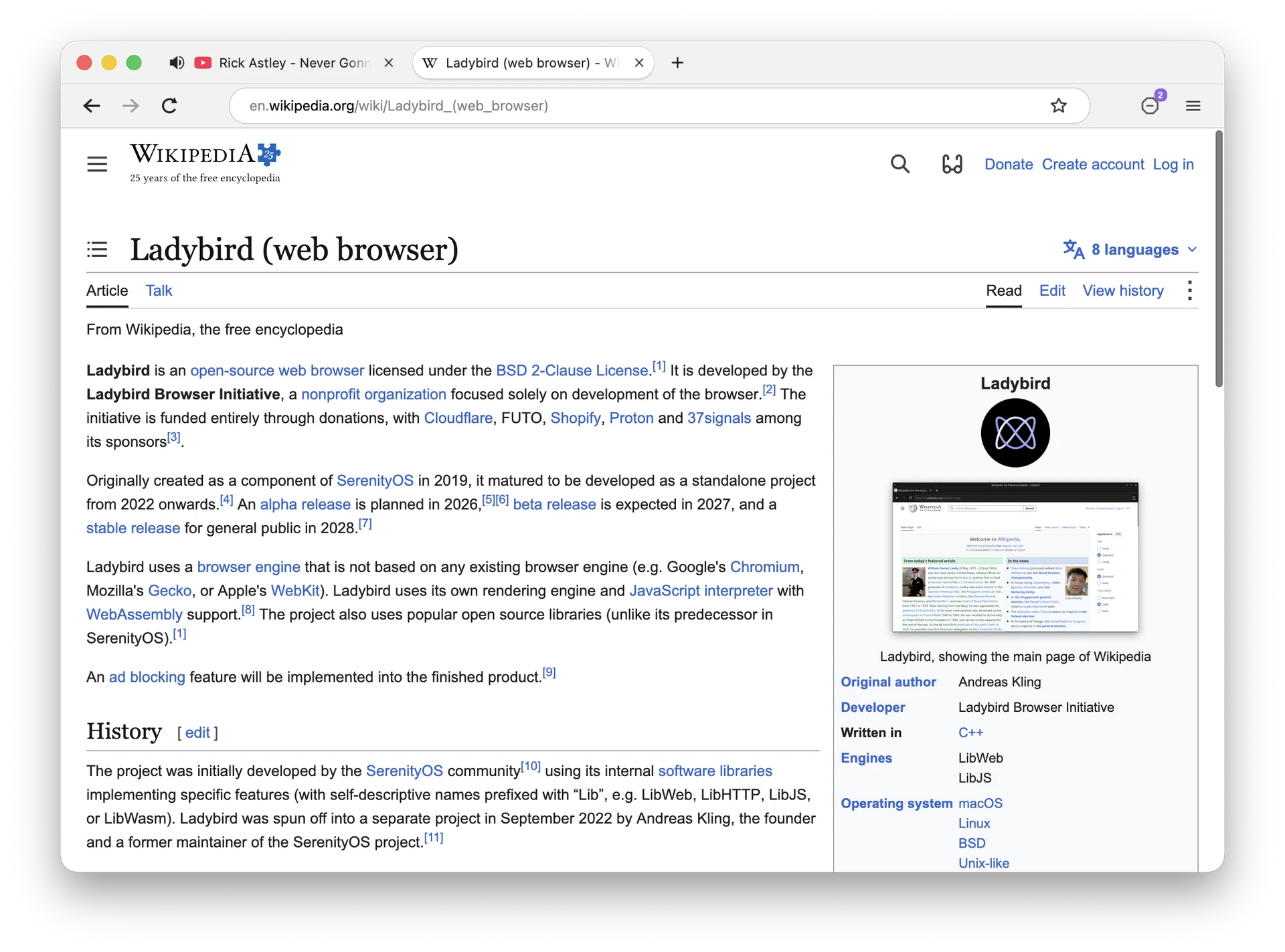
Presented is the first alpha release of the web browser Ladybird, which develops its own engine, independent of other projects, and offers an interface based on Qt. The product corresponds to the concept of “only a browser and nothing more.” At this stage, the browser is already suitable for working with most sites, including Twitch, Gmail and YouTube, but is not yet completely free of errors and problems when viewing some sites. The project code is written in C++ and Rust and is distributed under the BSD license. Ready-made assemblies generated for Linux (Flatpak, deb and rpm for Ubuntu and Fedora) and macOS.
Ladybird features include: support for current HTML, CSS and JavaScript standards, a JIT compiler for JavaScript, an engine for executing WebAssembly, the ability to hardware accelerate video decoding, private browsing mode, recovery sessions, rollback of changes (undo/redo), download manager, built-in PDF viewer, interface for browsing history and an inappropriate content blocker based on the adblock-rust library from the Brave project. To automate work with the browser, the WebDriver technology is supported, and for debugging sites there is a protocol compatible with Firefox DevTools.
The browser uses a multi-process architecture, in which the user interface and page rendering are divided into separate processes. Pages from different sites are processed in separate processes, isolated from the rest of the system using sandbox isolation. The operations of establishing network connections and decoding images for each site are also carried out in separate processes.
The project is developing the web engine LibWeb; JavaScript interpreter LibJS; LibWasm engine for WebAssembly; cryptographic libraries LibCrypto and LibTLS; HTTP client LibHTTP with HTTP/1.1 support; LibGfx library with functions of 2D graphics, image decoding and rendering; LibUnicode with functions for Unicode support and localization; LibMedia for audio and video playback; LibIPC interprocess communication mechanism.
The browser Ladybird is developed by Andreas Kling, who once worked at Nokia and developed KHTML, and then at Apple was one of the developers of Safari. The project was originally created as an application for the SerenityOS operating system, but in the summer of 2024 it was spun off into a separate project and received a donation of $1 million.